
Money laundering allows criminals to make illegally earned money appear legitimate. It can involve cash deposits, business transactions, international transfers, and property investments. For banks and financial institutions, identifying these activities is a major compliance challenge. Suspicious funds can pass through several accounts and transactions before their original source becomes difficult to trace.
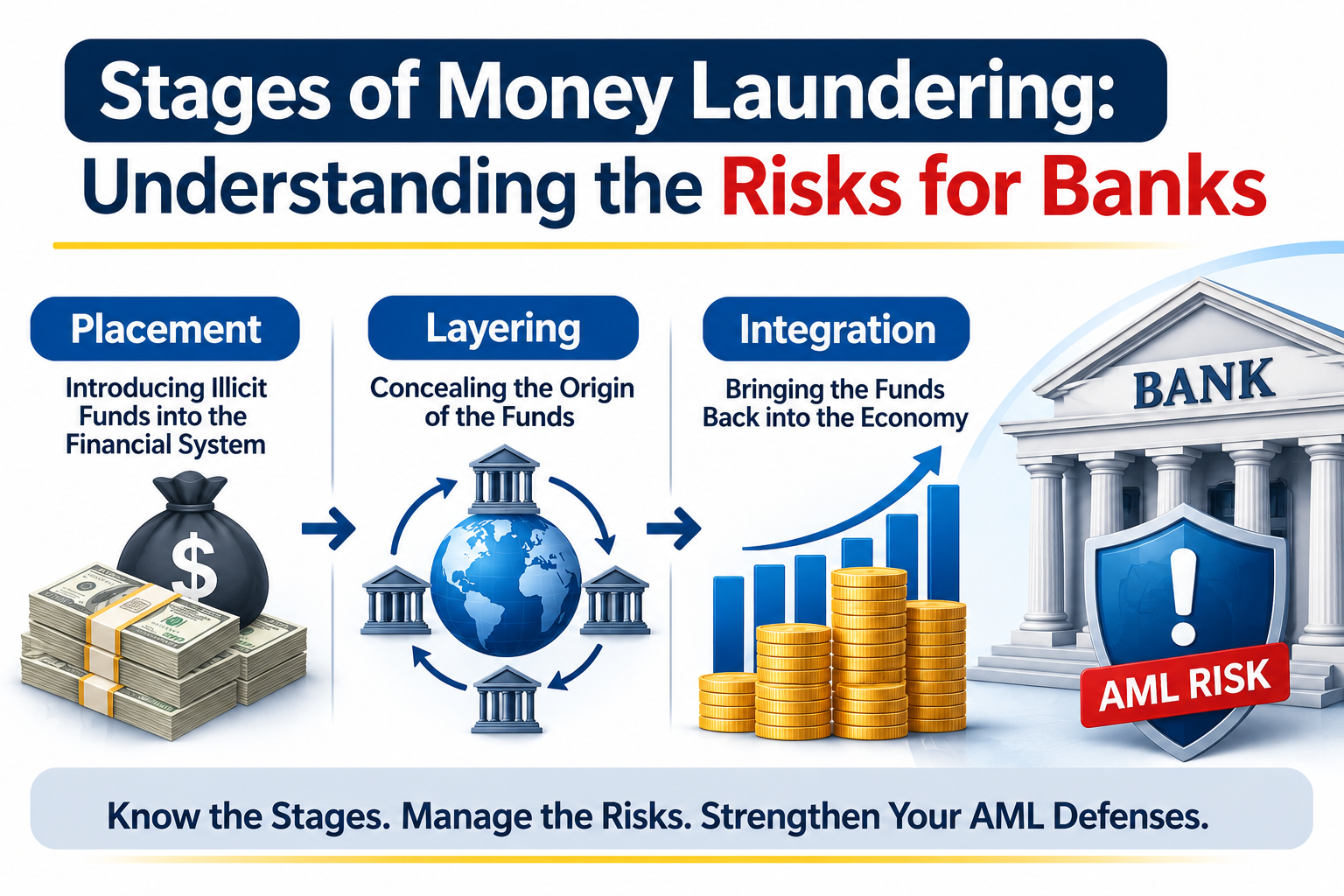
The process is commonly divided into three stages of money laundering: placement, layering, and integration. Each stage creates different risks for financial institutions and requires effective monitoring to identify unusual activity.
What Are the Three Stages of Money Laundering?
What is money laundering with example? its 3 stages of money laundering; explain how criminals try to conceal the source of their money. The stages are placement, layering and integration. It typically starts when the proceeds of crime enter the financial system. The money then travels from one transaction to another in order to conceal where it came from. Lastly, they get reintegrated into the economy in a seemingly authentic way. These four stages are often described in isolation but are not necessarily in order. Some activities may be repeated, and some money laundering schemes may lack stages, or stages may be repeated in different combinations. For banks, it is important to recognise this process, so they can detect odd financial activities. A transaction that looks like a normal transaction may be a red flag when you compare it to the customer’s financial record and other transactions.
See also: The Role of Cloud Computing in Modern Businesses and Everyday Life
Placement: Introducing Illegal Money Into the Financial System
The first phase of money laundering is placement. It is the process of bringing money generated by crime into the financial system. This is frequently undertaken via bank deposits, cash-based enterprises, or financial devices. For instance, an individual involved in unlawful operations may attempt to make several large deposits. The idea is to disguise the money as less suspicious and keep it off the radar. At this point, the banks have a significant challenge to address. The amount or frequency of cash deposits doesn’t necessarily mean the funds are the result of criminal activity. However, when transactions don’t align with a customer’s known income, business, or financial profile, that can raise concerns. Criminals could split up fairly large sums of cash into smaller sums or send illegal money into the banking system through financial instruments, according to the Financial Action Task Force (FATF). Compliance teams need to analyse transaction amounts and more. Other factors in evaluating possible placement risks include customer behaviour, the history of the account and the source of the funds.
Layering: Hiding the Origin of Illicit Funds Through Transactions
The second stage is called “layering” and is typically a series of financial transactions that obscures the origin of the money supply. After the money enters the financial system, criminals can shift the money from one bank account or financial institution to another or from one country to another. They can also turn to companies, investments, and other financial options to separate the money from the dirty money. Imagine a company account that receives funds, and there is no explanation for them. The funds are then directed to several accounts with different company names, with the final end use for an investment. Every transaction forms another layer between what is originally sent and where it is ultimately going. This activity may complicate investigations, especially for banks that facilitate global transactions and have high transaction numbers. At this time, transaction monitoring is particularly critical. AML Watcher provides financial institutions with transaction monitoring solutions, including 150+ expert-curated AML typologies and over 10,000 customizable rules. These features assist compliance staff in detecting unusual transactional activity and in evaluating the activity against relevant risk indicators.
Integration: Making Criminal Proceeds Appear Legitimate
Integration is the final stage of the three stages of money laundering. In this phase, the criminals try to legalise the money that has been removed from the economy. The cash can be spent on buying property, investing in business ventures, acquiring assets or other financial pursuits. The money may have been passed from person to person so that it is difficult to trace it to the original crime. A crime might include a layered funding scheme, for instance, to fund the purchase of a company office building. The rental income or eventual sale of that property can then be a legitimate reason for the funds. This can pose threats to banks, investment companies, and other financial institutions. The transaction may look reasonable, but the funds supporting it may have a hidden criminal source. Good due diligence and ongoing monitoring help institutions evaluate these risks. When analysing suspicious activity, review beneficial ownership, customer profiles, adverse media and transaction history to give context to the activity.
Strengthening Banking Controls Against Money Laundering Risks
Understanding the stages of money laundering is important, but identifying suspicious activity requires more than knowing how the process works. Banks need to connect customer information with transaction behaviour and respond when new risks emerge. A customer may have a consistent financial history during onboarding but show unusual activity months later. Similarly, several transactions may appear legitimate individually but reveal a suspicious pattern when reviewed together. This is where connected AML screening and transaction monitoring become valuable. AML Watcher helps financial institutions assess risk through transaction monitoring, sanctions screening, PEP screening, watchlist screening, and adverse media intelligence. Its transaction monitoring solution provides access to 150+ prebuilt AML typologies and 10,000+ customizable rules. Compliance teams can use these capabilities to review transaction patterns, identify potential anomalies, and apply monitoring logic based on their risk exposure. For banks managing complex financial activity, a stronger monitoring framework supports better visibility across the customer relationship. Explore AML Watcher to strengthen transaction monitoring and make more informed AML risk decisions.